jueves, 7 de mayo de 2020

How To Hack Any Whatsapp Account In 2020

The article will also be broken down into different subtopics and subcategories. This to make it easy for those who are just interested in skimming through the article to pick the part of WhatsApp hack they are most interested in. Just incase you don't have enough time to go through the entire article.

Search queries like these are a common place; Can WhatsApp be hacked? Can you read WhatsApp messages? How safe is the most popular trade fair in the world? This article gives you all the solution you need to hack any WhatsApp account, as well as how to protect yourself from a WhatsApp hack attack.

Although the messenger is now on an end-to-end encryption, WhatsApp is still not totally safe from espionage. WhatsApp chats and messages can still be accessed and read remotely, and old &deleted WhatsApp chats and messages retrieved.

WhatsApp Spy: Hack WhatsApp Chats and Messages

A very simple solution is to use a software that can hack WhatsApp remotely. All manufacturers offer to read the WhatsApp messages an extra web portal. In addition to the Whatsapp messages but can also spy on other messengers. So you can also have access to social media accounts.

The software may only be installed on a smartphone. If the user of the smartphone has been informed about the installation and effects.

WhatsApp Hacker: 3 Steps to Hack WhatsApp in 2020

You can hack Whatsapp using a second cell phone. No extra SIM card is necessary for this. The guide also works with a tablet. With this method, the other phone only needs to clone WhatsApp messages is internet connection.

The trick to hack Whatsapp successfully is not a software bug. It's the way WhatsApp has developed the setup wizard. Since there are no user accounts with passwords and you log in via the mobile number, here lies the vulnerability. But you can also protect yourself from the Whatsapp hack.

Hack WhatsApp Chat with the Best WhatsApp Hacking Tool

To read Whatsapp messages, the mobile phone number of the target must be known. The cell phone can remain locked. There is no need to install software to hack and read Whatsapp messages. Even with the PIN or fingerprint, the Whatsapp account can be hacked.

STEP 1: Create a New WhatsApp Account

To hack an account from Whatsapp, the app from the App Store must be installed on the second cell phone. After the installation of Whatsapp, target's phone number is entered. A confirmation request must be waited until access to the smartphone of the victim exists.

STEP 2: WhatsApp Account Confirmation

The confirmation of the Whatsapp account is the actual security risk of the messenger. Whatsapp usually confirms the registration via SMS. Occasionally the confirmation will also be sent by automated phone call via a phone call.

Calls and text messages can be read and taken by anyone even when the screen is locked. So that the WhatsApp hack does not stand out, the SMS must be removed from the start screen by swiping.

STEP 3: Enter Confirmation

The stolen verification PIN is now entered on the second smartphone. As a result, the WhatsApp account has been taken over by you. You can read the WhatsApp messages, which respond to this mobile phone number.

The downside to this trick is that the victim immediately notices the Whatsapp hack as soon as Whatsapp is opened. If the victim goes through the sign-in process again. The attacker loses access to the messages and no Whatsapp messages can be read.

How to Hack Someone's WhatsApp in 2020

A good way to hack a WhatsApp account is to hack whatsapp online. Here you can read WhatsApp messages via a browser and also write. The target user can continue to use his cell phone (works for iOS, Android phone etc) and does not notice the WhatsApp hack.

STEP 1: Access the Cell Phone

In order to be able to read WhatsApp messages by installing software. Access to the unlocked smartphone is required for a short time. In addition, cell phone, a computer or laptop is necessary. On this the Whatsapp messages will be read later.

STEP 2: Access WhatsApp Web

If you have access to the unlocked smartphone, Whatsapp must be started there. The Whatsapp settings include Whatsapp Web . If this is selected, Whatsapp opens a QR code scanner with the hint to open WhatsApp Web in the browser.

If the QR code is scanned in the browser with the smartphone. There is a permanent connection and Whatsapp messages can be read. If you want to hack Whatsapp in this way. You have full access to all incoming messages and you can even write messages yourself.

STEP 3: Read WhatsApp Messages

The target usually sees this Whatsapp hack only when the settings are invoked to Whatsapp Web in the app. Whatsapp messages can be read via the browser. Regardless of whether the smartphone is on home Wi-Fi or on the move. You can also hack group chats admin by just having any of the contact details.

WhatsApp Hack: How to Hack any WhatsApp account

Which is the most popular messaging app globally? Of course, you can use different apps from Android or iOS to send and receive messages. But Whatsapp remains everyone's favorite globally!

Whatsapp is one of the popular apps in the world. There are more than 2 billion active users on Whatsapp, messaging daily with the app. Why do people love WhatsApp? Whatsapp is very convenient and easy to use.

Other messaging apps like Facebook Messenger, still needs a special account to sign up for this app. If you change a new app, you'll need to add another account. This can be stressful, as you have to remember a lot of new passwords and usernames.

HACKER NT

Related word

miércoles, 6 de mayo de 2020

Ethical Hackers Platform: How To Install A bWAPP In Windows 2018


bWAPP, or a buggy web application, is a free and open source deliberately insecure web application. It helps security enthusiasts, developers and students to discover and to prevent web vulnerabilities. bWAPP prepares one to conduct successful penetration testing and ethical hacking projects.

What makes bWAPP so unique? Well, it has over 100 web vulnerabilities!
It covers all major known web bugs, including all risks from the OWASP Top 10 project.  bWAPP is for web application security-testing and educational purposes only.

Have fun with this free and open source project!
bWAPP is a PHP application that uses a MySQL database. It can be hosted on Linux/Windows with Apache/IIS and MySQL. It can also be installed with WAMP or XAMPP. Another possibility is to download the bee-box, a custom Linux VM pre-installed with bWAPP.

First of all you have need to install a local server over system that may be XAMPP, WAMP or LAMP. These servers are totally free of cost you can freely download from the internet. Mostly XAMPP is used because it has more functionalities than others on the other hand WAMP is also a simple platform for PHP while, LAMP is used over the Linux distributions. After downloading any one of them you have need to install that first after that you'll be able to configure bWAPP over your system.

Why we use the software application for configuring this bWAPP? As we know PHP is a server side language and there must be a server to read the PHP script. Without using any server we can't do programming with PHP. If you have a little piece of code of PHP you must install a server in your system for running that PHP script.

Enter the command ipconfig. You will get results similar to the ones shown below

Ultimate guide to DoS(Denial of Service) Attacks

For this example, we are using Mobile Broadband connection details. Take note of the IP address. Note: for this example to be more effective, and you must use a LAN network.

 Switch to the computer that you want to use for the attack and open the command prompt

We will ping our victim computer with infinite data packets of 65500

Enter the following command

ping 10.128.131.108 –t |65500

HERE,

  • "ping" sends the data packets to the victim
  • "10.128.131.108" is the IP address of the victim
  • "-t" means the data packets should be sent until the program is stopped
  • "-l" specifies the data load to be sent to the victim

You will get results similar to the ones shown below

Ultimate guide to DoS(Denial of Service) Attacks

Flooding the target computer with data packets doesn't have much effect on the victim. In order for the attack to be more effective, you should attack the target computer with pings from more than one computer.

The above attack can be used to attacker routers, web servers etc.

If you want to see the effects of the attack on the target computer, you can open the task manager and view the network activities.

  • Right click on the taskbar
  • Select start task manager
  • Click on the network tab
  • You will get results similar to the following

Ultimate guide to DoS(Denial of Service) Attacks

If the attack is successful, you should be able to see increased network activities.


Hacking Activity: Launch a DOS attack

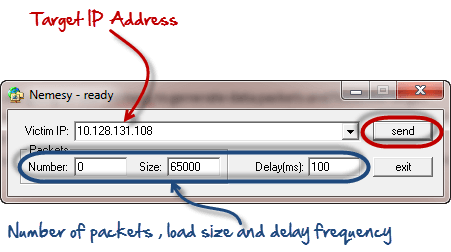
In this practical scenario, we are going to use Nemesy to generate data packets and flood the target computer, router or server.

As stated above, Nemesy will be detected as an illegal program by your anti-virus. You will have to disable the anti-virus for this exercise.

Ultimate guide to DoS(Denial of Service) Attacks

Enter the target IP address, in this example; we have used the target IP we used in the above example.

HERE,

  • 0 as the number of packets means infinity. You can set it to the desired number if you do not want to send, infinity data packets
  • The size field specifies the data bytes to be sent and the delay specifies the time interval in milliseconds.


Click on send button

You should be able to see the following results

Ultimate guide to DoS(Denial of Service) Attacks

The title bar will show you the number of packets sent

Click on halt button to stop the program from sending data packets.

You can monitor the task manager of the target computer to see the network activities.

Summary

  • A denial of service attack's intent is to deny legitimate users access to a resource such as a network, server etc.
  • There are two types of attacks, denial of service and distributed denial of service.
  • A denial of service attack can be carried out using SYN Flooding, Ping of Death, Teardrop, Smurf or buffer overflow
  • Security patches for operating systems, router configuration, firewalls and intrusion detection systems can be used to protect against denial of service attacks.
@EVERYTHING NT

Continue reading


  1. Hacking Iphone
  2. Hacker Seguridad Informática
  3. Geekprank Hacking
  4. Hacking Web Sql Injection
  5. Hacking Wifi Windows
  6. Seguridad Y Hacking

BeEF: Browser Exploitation Framework


"BeEF is the browser exploitation framework. A professional tool to demonstrate the real-time impact of XSS browser vulnerabilities. Development has focused on creating a modular structure making new module development a trivial process with the intelligence residing within BeEF. Current modules include the first public Inter-protocol Exploit, a traditional browser overflow exploit, port scanning, keylogging, clipboard theft and more." read more...


Website: http://www.bindshell.net/tools/beef


More information


  1. Hacking Bluetooth Speaker
  2. Foro Hacking
  3. Hacking Etico
  4. Ethical Hacking Course
  5. Hacking Quotes

viernes, 1 de mayo de 2020

How To Download And Install Prototype 2 Full Version On PC (With Proof)

Download Naruto Shippuden Ultimate Ninja Storm 4 Road To Boruto For PS4

Download Naruto Shippuden Ultimate Ninja Storm 4 Road to Boruto For PS4

FPKG | CUSA06210 | Update v1.02 | 

  • Release Date: Out Now
  • Genre: Action / Fighting
  • Publisher: BANDAI NAMCO Entertainment Inc.
  • Developer: CyberConnect2 Co., Ltd.


With more than 13 million NARUTO SHIPPUDEN™: Ultimate Ninja® STORM games sold worldwide, this series has established itself among the pinnacle of Anime & Manga adaptations to videogames! NARUTO SHIPPUDEN: Ultimate Ninja STORM 4 Road to Boruto concludes the Ultimate Ninja Storm series and collects all of the DLC content packs for Storm 4 and previously exclusive pre-order bonuses! Not only will players get the Ultimate Ninja Storm 4 game and content packs, they will also get an all new adventure Road to Boruto which contains many new hours of gameplay focusing on the son of Naruto who is part of a whole new generation of ninjas.
• All Ultimate Ninja Storm 4 Content in One Edition – Includes the Ultimate Ninja Storm 4 game, 3 DLC packs from the Season Pass (Gaara's Tale Extra Scenario Pack, Shikamaru's Tale Extra Scenario Pack, and the Sound Four Extra Playable Character's Pack), the all new Road to Boruto DLC, and all the previously exclusive pre-order bonus content
• New Generation Systems – With development made specifically to leverage the power of PlayStation®4. Road to Boruto will take players through an incredible journey of beautifully Anime-rendered fights!
• Huge Character Roster and New Hidden Leaf Village – Additional playable characters including Boruto, Sarada, Mitsuki, and Sasuke (Wandering Shinobi) and a new setting of a New Hidden Leaf Village
• New Collection and Challenge Elements that extends gameplay


domingo, 26 de abril de 2020

Save Your Cloud: DoS On VMs In OpenNebula 4.6.1

This is a post about an old vulnerability that I finally found the time to blog about. It dates back to 2014, but from a technical point of view it is nevertheless interesting: An XML parser that tries to fix structural errors in a document caused a DoS problem.

All previous posts of this series focused on XSS. This time, we present a vulnerability which is connected another Cloud Management Platform: OpenNebula. This Infrastructure-as-a-Service platform started as a research project in 2005. It is used by information technology companies like IBM, Dell and Akamai as well as academic institutions and the European Space Administrations (ESA). By relying on standard Linux tools as far as possible, OpenNebula reaches a high level of customizability and flexibility in hypervisors, storage systems, and network infrastructures. OpenNebula is distributed using the Apache-2 license.


OpenNebula offers a broad variety of interfaces to control a cloud. This post focuses on Sunstone, OpenNebula's web interface (see Figure 1).

Figure 1: OpenNebula's Sunstone Interface displaying a VM's control interface

Before OpenNebula 4.6.2, Sunstone had no Cross-Site Request Forgery (CSRF) protection. This is a severe problem. Consider an attacker who lures a victim into clicking on a malicious link while being logged in at a private cloud. This enables the attacker to send arbitrary requests to the private cloud through the victims browser. However, we could find other bugs in OpenNebula that allowed us to perform much more sophisticated attacks.

Denial-of-Service on OpenNebula-VM

At its backend, OpenNebula manages VMs with XML documents. A sample for such an XML document looks like this:
<VM>
   <ID>0</ID>
   <NAME>My VM</NAME>
   <PERMISSIONS>...</PERMISSIONS>
   <MEMORY>512</MEMORY>
   <CPU>1</CPU>
   ...
</VM>
OpenNebula 4.6.1 contains a bug in the sanitization of input for these XML documents: Whenever a VM's name contains an opening XML tag (but no corresponding closing one), an XML generator at the backend automatically inserts the corresponding closing tag to ensure well-formedness of the resulting document. However, the generator outputs an XML document that does not comply with the XML schema OpenNebula expects. The listing below shows the structure that is created after renaming the VM to 'My <x> VM':
<VM>
   <ID>0</ID>
   <NAME>My <x> VM</x>
      <PERMISSIONS>...</PERMISSIONS>
      <MEMORY>512</MEMORY>
      <CPU>1</CPU>
      ...
   </NAME>
</VM>
The generator closes the <x> tag, but not the <NAME> tag. At the end of the document, the generator closes all opened tags including <NAME>.

OpenNebula saves the incorrectly generated XML document in a database. The next time the OpenNebula core retrieves information about that particular VM from the database the XML parser is mixed up and runs into an error because it only expects a string as name, not an XML tree. As a result, Sunstone cannot be used to control the VM anymore. The Denial-of-Service attack can only be reverted from the command line interface of OpenNebula.

This bug can be triggered by a CSRF-attack, which means that it is a valid attack against a private cloud: By luring a victim onto a maliciously crafted website while logged in into Sunstone, an attacker can make all the victim's VMs uncontrollable via Sunstone. A video of the attack can be seen here: